
Bhunte met Maila after many months near the water hole. Maila was restless and moving around sniffing the air. Maila was in his 15th years when he left his herd. Bhunte never understood why he left. Bhunte gently approached Maila and requested him to tell him why he left his herd. Maila avoided Bhunte and started looking for someone. Bhunte kept on following him and was even kicked down by Maila. Bhunte carefully observed that the lateral sides of Maila’s forehead were swollen and some fluid was cascading down. Maila was continuously dribbling urine and his mouth was wide open. He did not bother to answer Bhunte’s question. Disappointed Bhunte came back to his herd. In his herd, he asked Kaale about Maila’s strange behaviour. Kaale patted Bhunte’s head with his trunk and smiled. Kaale explained “Bhunte, when a male elephant reaches his sexual maturity or pubertal age, he leaves his herd. Maila is in his “musth“- a sexually active period. Did you see his forehead swollen? And some pungent fluid floating down?” Bhunte nodded and said- “Yes. I did”. Kaale continued ” That is called a temporal gland. And that fluid- “temporin”. When elephants are in musth– there is a continuous secretion of temporin and they also dribble urine. That is the phase when elephants’ male reproductive hormone “Testosterone” is at the peak. They remain restless and search for their mates. They feed less and move a lot. Many times, you might have heard many male elephants in temples and captivity, attack humans during their musth and they conclude that elephants are aggressive during musth! It is not so- because, at this time, they need to move a lot and search for their female partners. But sadly, they are chained and shackled. Restricting our movements- of course, will make us angry!” Kaale, then, went to drink water. Bhunte was surprised to hear about the musth. He wished that all the handlers of the temple and captive elephants too knew about this. That being in “musth” does not make elephants dangerous and rogue! But restricting their natural behaviour does!
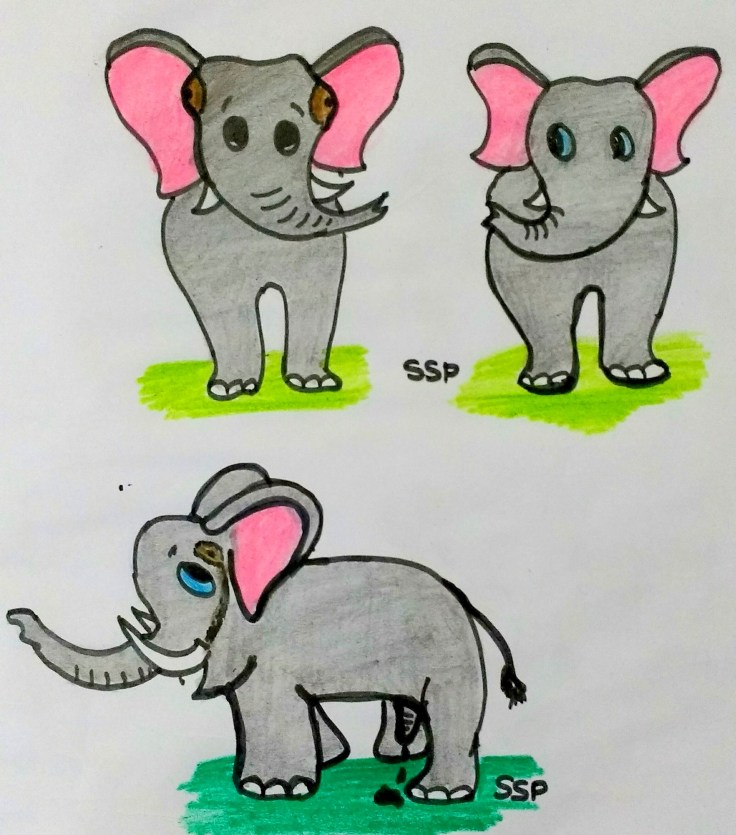
 Bhunte: The baby elephant
Leave a comment