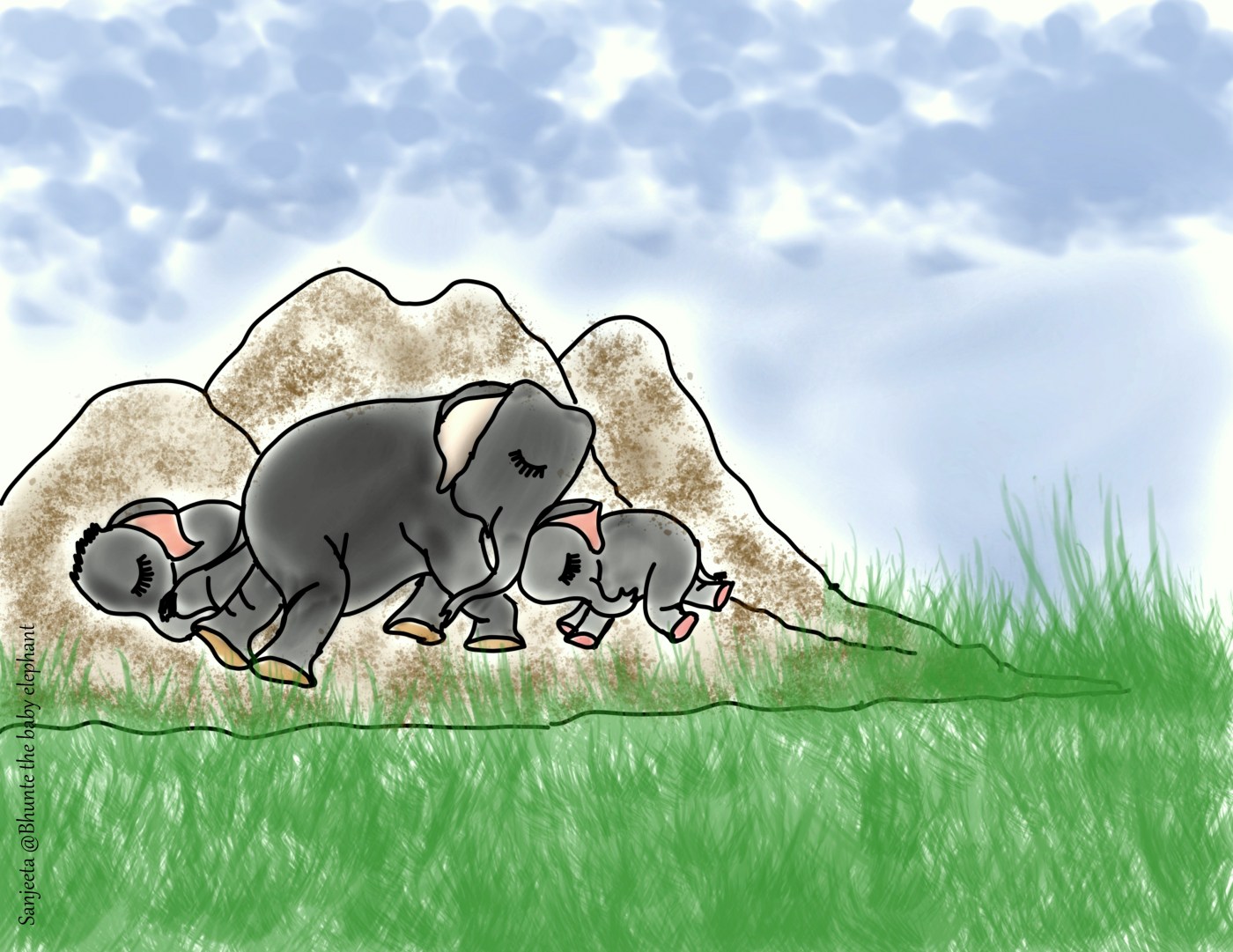
It was a long hazy day. Bhunte and Sanu were tired and started sluggishly following their mother. On their way, while grazing, Bhunte’s mother spotted termite mounds. She bent and rested against the mound, while her other herd members started grazing nearby. Sanu who was walking ahead of her mother- pushed herself near her mother’s trunk and went to sleep, while Bhunte squeezed himself behind his mother, her tail touching his trunk to ensure he was safe. After a short nap*, she woke up and followed her herd, while Bhunte and Sanu were too lazy to get up. A gentle nudge from her, and Bhunte woke up! He pulled up Sanu. They followed their mother silently, without throwing any tantrums…
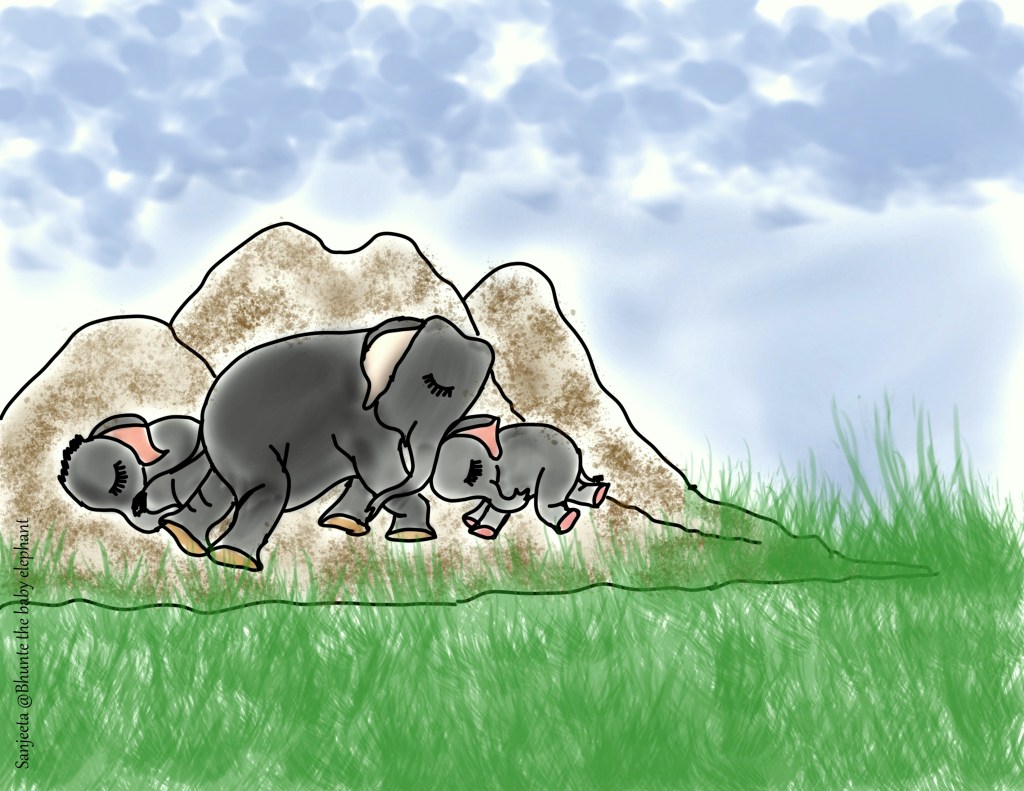
*Science behind Bhunte’s sleep: Elephants are short-sleepers (two to three hours or even going without sleep for days!) when they are in the wild (only studied in African elephants). Studies in captivity show elephants sleep for almost five to six hours, while in the wild- they tend to sleep less. This could be due to probable chances of being exposed to predation (especially, the young ones) and more time required in foraging than resting (sparsely available resources, spending more time searching for resources); neurologically, orexin neurons of the hypothalamus in elephants keep them awake to maximize the energy intake. That could be the reason that large mammals/herbivores sleep less! African matriarchs had REM sleep every third/fourth day! REM (Rapid eye movement) or deep sleep helps in memory consolidation (temporary memory is transformed into a long-lasting form), which means elephants’ memory formations may not depend on the sleep cycle (more needs to be explored!). Elephants sleep by resting down against the trees/mounds/rocks/ elevated ground (lateral recumbency) as Bhunte, Sanu and their mother did, and standing or standing against the trees. However, more studies are warranted to fully understand the sleep behaviour in both species of elephants.
~Sanjeeta Sharma Pokharel
 Bhunte: The baby elephant
Leave a comment