As the tropical summer grew hotter each day, Bhunte, now almost a grown-up elephant, stood quietly beneath a tall Acacia tree. The shade was cool, and he enjoyed watching little Sano nearby. Like Bhunte, Sano had become very fond of chasing butterflies and following wagtails through the grass. She darted from one flower to another, her tiny trunk waving with excitement. Bhunte let out a soft rumble.
“Sano, come here for a moment,” he rumbled. Sano hurried over. With her curious trunk, she gently touched Bhunte’s trunk. “Tell me a story!,” she roared.
Bhunte shook his head and sighed, “Very well,” he trumpeted. “But first, look at how hot the summer has become. And yet, far away from these tropical forests where we live and play, there is a place much hotter and drier.”
“Hotter than this?” Sano was curious! “Much hotter,” trumpeted Bhunte. “It is called Namibia.”
Sano’s eyes grew wide.
“Namibia has great deserts,” Bhunte continued. “In some places, there is hardly any rain. There are long stretches of sand and very few plants.” Sano could hardly believe it.
“How can elephants live there?” she asked.
“That is exactly what I wondered,” Bhunte replied. “My uncle, Tek Bahadur, once heard a story from some humans about a magnificent desert elephant named Nangolo.”
“Nangolo?” Sano repeated. Bhunte nodded.
“They say Nangolo could travel across the desert for many days, without water and food. He walked through the hot sands where few animals dared to go.”
Sano shook her head. “That can’t be possible! No elephant could do that!”
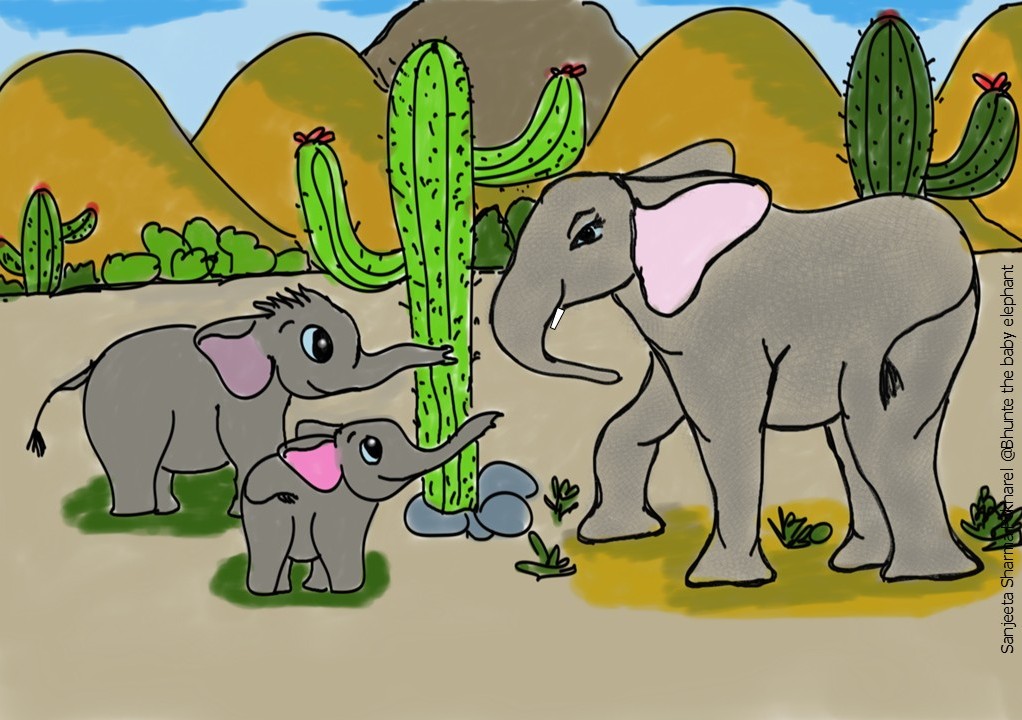
Bhunte chuckled. “Oh, but Nangolo and his relatives are special desert elephants. For many generations, they have adapted to life in the desert. They have longer legs that help them travel great distances and broad, flat feet that help them walk on soft sand. And the narrow body shape!” Sano listened carefully.
“And do you know something else?” Bhunte asked.
“What?” she whispered.
“When we eat, we sometimes pull up entire plants. But Nangolo and his relatives are often gentler with the desert plants. They break branches and feed carefully so that many plants can continue to grow. In such a harsh place, every plant is precious for them!” Sano imagined the endless desert and the clever elephants that called it home.
“They also eat thorny plants and succulents,” Bhunte added. “Plants that I would find very difficult to enjoy!”
He rubbed his right eye with his trunk and shook his head sideways!
“I think I would go quite mad if I had to live in Namibia!” Sano chirped.
Then Bhunte lowered his voice. “You know, Nangolo has a niece. Her name is Tuyeimo.”
“Really?” said Sano. “Yes. I often wonder what she is like. Perhaps one day we will meet her on the desert plains of Namibia. We could ask her all about desert life and whether the nights are as cold as the days are hot.”
Sano nodded eagerly. “I would like that.”
Just then, a mischievous myna swooped past and chirped loudly near her ears.
“There you are!” trumpeted Sano, racing after the bird through the grass.
Bhunte watched her run. Then he leaned comfortably against the Acacia tree, closed his eyes, and began to dream of distant deserts, golden sands, and a young elephant named Tuyeimo waiting somewhere beneath the Namibian sky.
Story and art by Sanjeeta Sharma Pokharel
Learn more about Namibian Desert Elephants:


Leave a Reply